From Prompts to Pipelines: Build an Orchestrated AI Content System

Most teams think the fix is better prompts. Faster drafts. More outputs. I’ve run that play. It works until you try to run it every day, across dozens of topics, with real standards and a real CMS. Then the wheels wobble. One missed image spec here, a broken schema tag there, tone drift everywhere.
Back when we hit 120k monthly readers at Steamfeed, volume wasn’t the problem. Consistency was. Later, as the only marketer at a SaaS, I could outwrite a whole team because I had the context in my head. As the team grew, that context didn’t scale. Prompts helped, but we were still babysitting structure, links, and publishing. That’s the gap. Prompts write words. Systems ship content.
Key Takeaways:
- Treat content as a pipeline, not a paragraph; move rules from prompts into system configuration
- Separate creativity from correctness; let prose vary, keep links, schema, and publishing deterministic
- Quantify cleanup and failure costs; redirect hours from rework to differentiation
- Enforce strategy with Topic Universe, coverage states, and cooldowns to avoid cannibalization
- Gate briefs with Information Gain so originality is decided before writing
- Use QA gates (min pass 85) to assign quality to the system, not a heroic editor
- Publish through mapped connectors with idempotency and rollback to reduce risk
Why Prompt Engineering Breaks At Production Scale
Prompt engineering breaks at scale because it can’t enforce structure, accuracy, or publishing rules across dozens of articles. Teams end up editing outputs manually, which reintroduces inconsistency and rework. A better approach treats content as a pipeline with checks for tone, facts, visuals, and delivery.

The unit of work is a pipeline, not a paragraph
You don’t scale by perfecting a single draft. You scale by defining a governed flow: topic selection, differentiation, writing, visuals, QA, and publish. Each stage has inputs, checks, and outputs. Most prompt libraries miss that. They act like macros, not operations.
Here’s the shift. Separate creativity (the words) from correctness (the mechanics). Let the writing breathe inside guardrails, but lock the brittle pieces in code, internal links, schema, filenames, image ratios, field mapping. This mirrors how modern AI work is actually executed. If you want a broader view, skim Deloitte’s outlook on AI agent orchestration. Different domain, same lesson: systems beat prompts.
Document the rules once. Voice, phrasing patterns, banned terms. Section structure. Image placement rules. QA thresholds. Then measure pass/fail at the system level. The draft becomes a stage output, not the finish line.
What is an orchestrated content system?
Think fixed sequence with gates: Topic → Brief → Draft → Visuals → QA → Publish. Facts come from a knowledge base, tone from a brand studio, both applied at every stage. No guessing where precision matters: internal links and schema are deterministic; publishing is mapped and idempotent.
You also need memory and retries. Log inputs and outputs. If a draft fails QA, the system doesn’t shrug; it loops and tries again with clear reasons. If you’re newer to this, this plain-English overview of AI orchestration is useful. It’s not about dashboards. It’s about a consistent pipeline that can recover without heroics.
Why prompt libraries still drift over time
Templates reduce variance, but they don’t enforce structure, links, visuals, or publishing. Without a knowledge base, facts trend generic or wrong. Voice guidelines in prose get interpreted differently by every writer, and every model update. Over a quarter, drift compounds.
Fix the engine, not the driver. Move constraints from prompts into configuration. Apply them during drafting and QA. This mirrors what practitioners report in Forrester’s research on orchestration’s role: orchestration reduces operational friction because the rules live in the system, not in someone’s head.
Ready to skip theory and see a pipeline produce real drafts? Try Generating 3 Free Test Articles Now. Try Generating 3 Free Test Articles Now
The Real Bottleneck Is Disconnected Steps, Not Writing Speed
The real bottleneck is fragmentation, strategy, differentiation, structure, visuals, and publishing live in different tools. Intent gets lost in handoffs. A coordinated system converts strategy into briefs, guards originality, and automates the mechanics so teams focus on what only humans do well.

What traditional approaches miss in strategy handoffs
Strategy often lives in slides and spreadsheets. Drafts live in prompts. The gap between them creates inconsistent intent. Writers are asked to infer priorities from a keyword list and a paragraph of “voice.” That’s a guess, not a contract.
Define a Topic Universe. It maps your topic landscape into clusters tied to product pillars, tracks coverage and saturation, and enforces cooldowns. When a topic gets picked, it becomes a brief with required sections, evidence, and an angle. No open-ended prompts. Uniqueness is measured before writing starts, not after you’ve edited a draft for three hours.
Where teams misplace governance, inside the draft instead of the system
Governance stuffed into prompts is optional. Governance embedded in the pipeline is non-negotiable. Codify voice rules, banned terms, schema patterns, image ratios, and linking rules in configuration, not scattered checklists.
Quality gates should score structure, KB accuracy, and snippet readiness. Drafts below the threshold loop for refinement. Publishing should be idempotent with mapped fields and duplicate prevention. When this is codified, you stop betting on perfect handoffs, and you start trusting the system.
The Hidden Costs You Can Quantify Today
Prompt-centric workflows leak time in cleanup, duplication, and failed publishes. You can estimate those losses now. Quantifying costs creates budget for the fix, turning ad hoc edits into system-level rules that reduce rework and risk in a repeatable way.
Engineering hours lost to rework and image wrangling
Let’s pretend you ship 20 posts per month and spend 1.5 hours per post fixing links, images, and schema. That’s 30 hours monthly. At $120/hour loaded, you’re at $3,600 just to clean up. That time rarely creates value; it avoids embarrassment.
This isn’t hypothetical for many teams. A similar pattern shows up in a case study of orchestration in a marketing agency: manual glue work is where hours go to hide. Move linking, image placement, and schema to code so humans work on differentiation and story, not alt text and anchors.
What does a failed publish cost your brand this quarter?
Let’s pretend one in ten publishes fails due to broken mapping or duplicate slugs. Two hours each across content and dev to fix it. That’s time, plus reputational risk from bad previews or duplicate URLs floating in the wild.
Idempotent publishing and rollback cut this risk. Make publishing a controlled, repeatable operation with field mapping, duplicate prevention, and safe draft modes. You won’t remove every issue, but you’ll turn failures into quick fixes instead of fire drills.
When Shipping Feels Like Guesswork, Quality Slips And Morale Follows
When every publish feels fragile, teams slow down and second-guess. Editors become traffic cops. Writers stop pushing for originality because cleanup always wins the day. The work gets safer, and ironically, more random. No one wants that job.
When your best idea ships without the product tie-in
You can rank for tangential keywords and still miss pipeline. I’ve been there. At one company, we had great writers and designers. We ranked incredibly well for broad sales topics. The problem? The content sat too far from the product’s core. Lots of traffic, low intent, little movement for sales.
Tie clusters to product value early. Require solution alignment inside briefs, not as an afterthought. If the narrative can’t point to a real product moment, it’s either the wrong topic or the wrong angle. Fix the map, then the article.
Who owns quality when everyone is editing everything?
Shared docs feel collaborative, until no one owns outcomes. Diffusion of responsibility is real. People assume someone else caught it. Missed schema. Off-brand phrasing. Broken image paths.
Assign ownership to the system. QA checks enforce rules and pass or fail against a clear threshold, say, 85 or above to ship. Editors design QA policies. Writers curate the knowledge base. The pipeline enforces structure and mechanics. Fewer late-night edits. More confidence when you press publish.
If this sounds like the environment you want, consider taking the engine for a spin. Try Using an Autonomous Content Engine for Always-On Publishing. Try Using an Autonomous Content Engine for Always-On Publishing
Design A Deterministic Pipeline From Strategy To Publish
A deterministic pipeline turns strategy into shipping without guesswork. Use Topic Universe for coverage, brief gating for originality, and code for the brittle parts, links, schema, visuals, and publishing. Humans steer narrative; the system enforces rules.
Map strategy into a Topic Universe and cluster taxonomy
Start by aggregating topics from your knowledge base, sitemap, and focus areas. Group them into clusters tied to product outcomes. Label each cluster’s saturation, underserved, healthy, well-covered, saturated, and enforce cooldowns so you don’t over-publish one idea while neglecting others.
This becomes your intake. Approved topics must map to a cluster and an intent. You stop chasing interesting ideas and start building authority intentionally. Bonus: it also prevents cannibalization because the system knows what’s already covered, and when it’s safe to revisit.
Generate differentiated briefs with information gain thresholds
Don’t gamble on uniqueness after drafting. Analyze the top-ranking coverage first. Identify what’s common, what’s missing, and where explanations are shallow. Then calculate an Information Gain score between 0 and 100. Gate briefs below a threshold, say, 65.
Include three to five external source candidates with suggested anchors, each tied to a specific gap. Approve only briefs that add net-new signal. This approach aligns with how mature teams reduce drift and redundancy long before writing begins.
Orchestrate drafting, visuals, deterministic linking, schema, QA, and publish
Once the brief clears, draft to it, no detours. Enforce snippet-ready H2 openers and ground claims with your knowledge base. Generate visuals from a brand asset library, match screenshots to relevant sections, and auto-generate alt text and filenames.
Then let code handle internal links from your verified sitemap, programmatic schema, and QA gates. Minimum pass score, or it loops. Publish via mapped connectors with idempotency and rollback. The point isn’t perfection. It’s predictability, even on bad days.
How Oleno Turns Strategy Into Publish-Ready Articles
Oleno runs a closed-loop system that converts strategy into complete, on-brand articles. It handles Topic Universe, brief differentiation, drafting, visuals, QA, and publishing, end to end, so teams spend time on narrative and product, not plumbing.
Topic Universe and saturation control that prevent redundancy
Oleno maps your topic landscape automatically from your knowledge base and sitemap, grouping topics into clusters and labeling saturation states in real time. You’ll see where you’re underserved, healthy, well-covered, or saturated, and a cooldown prevents premature re-coverage.
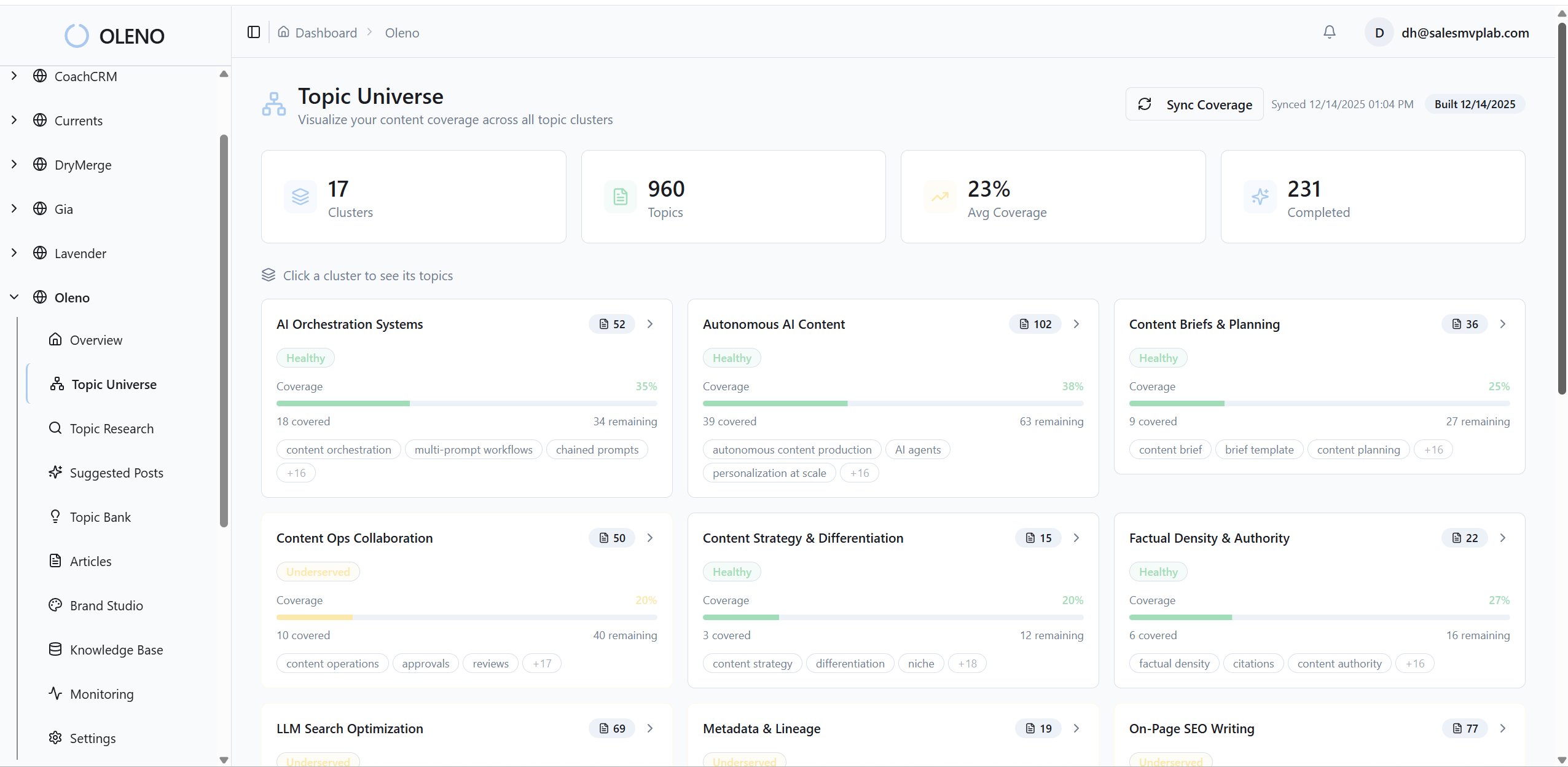
Daily suggestions appear tied to gaps, not guesses. Approvals move directly into generation. The outcome is simple: a reliable queue of the right ideas, with the cadence to compound authority without cannibalization. It’s deliberate, not reactive.
Information Gain briefs that block low-value drafts up front
During brief generation, Oleno performs competitive research, identifies missing perspectives and shallow explanations, and assigns an Information Gain score. Low-gain briefs trigger warnings and don’t advance. High-gain briefs move forward with external source candidates and suggested anchors already attached.
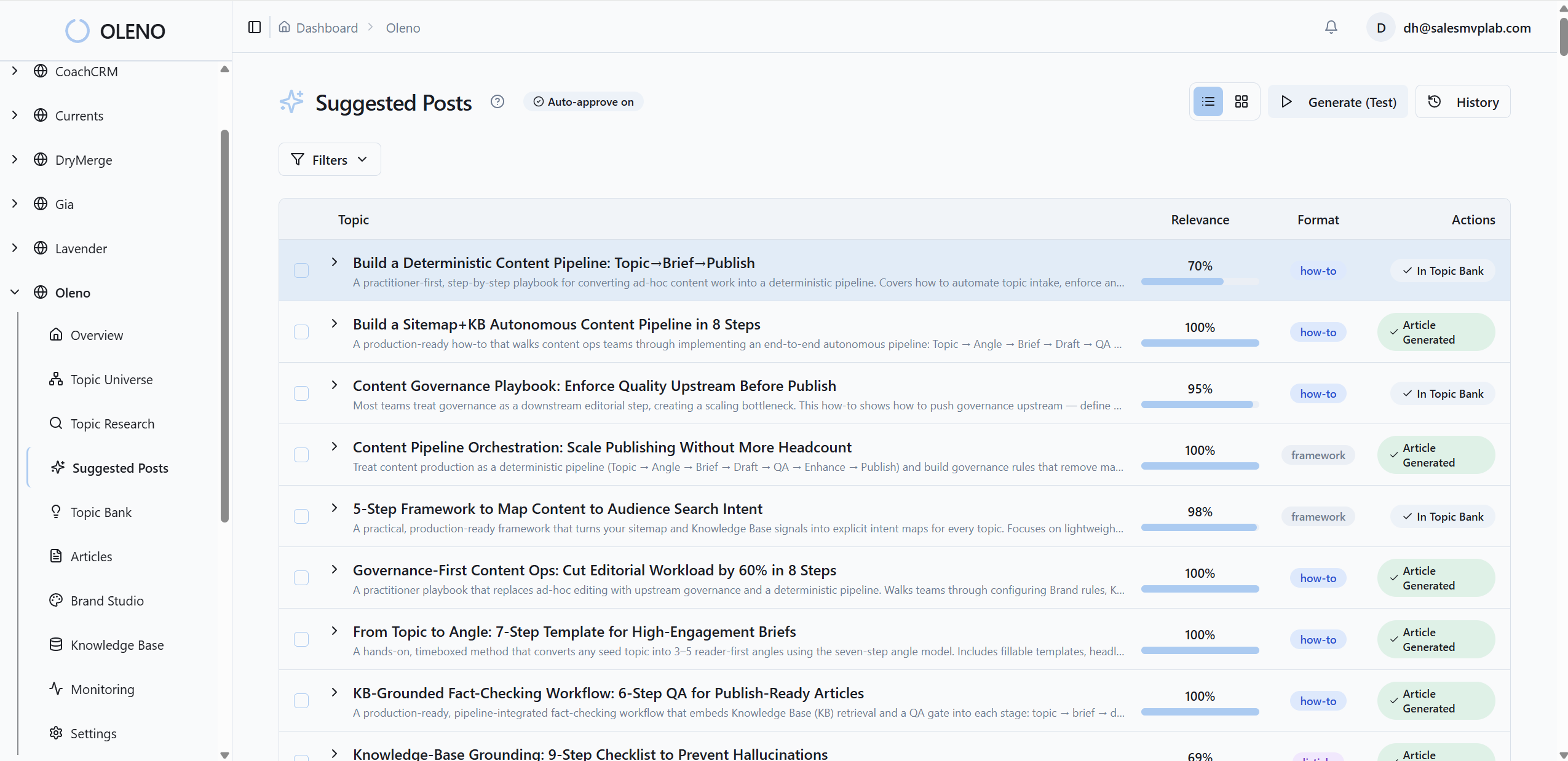
This shifts effort earlier, where it’s cheaper. You save hours you used to spend editing half-original drafts. You publish fewer articles, each with more net-new signal. Over a quarter, that compounds into authority you can feel across clusters.
Deterministic links, schema, QA gates, and CMS connectors
Oleno takes the brittle mechanics off your plate. Internal links are injected from a verified sitemap only, with anchor text matching page titles. Schema (Article, FAQ, BreadcrumbList) is generated and validated programmatically. Visual Studio produces brand-consistent hero and inline images and matches product screenshots to the right sections with semantic similarity.
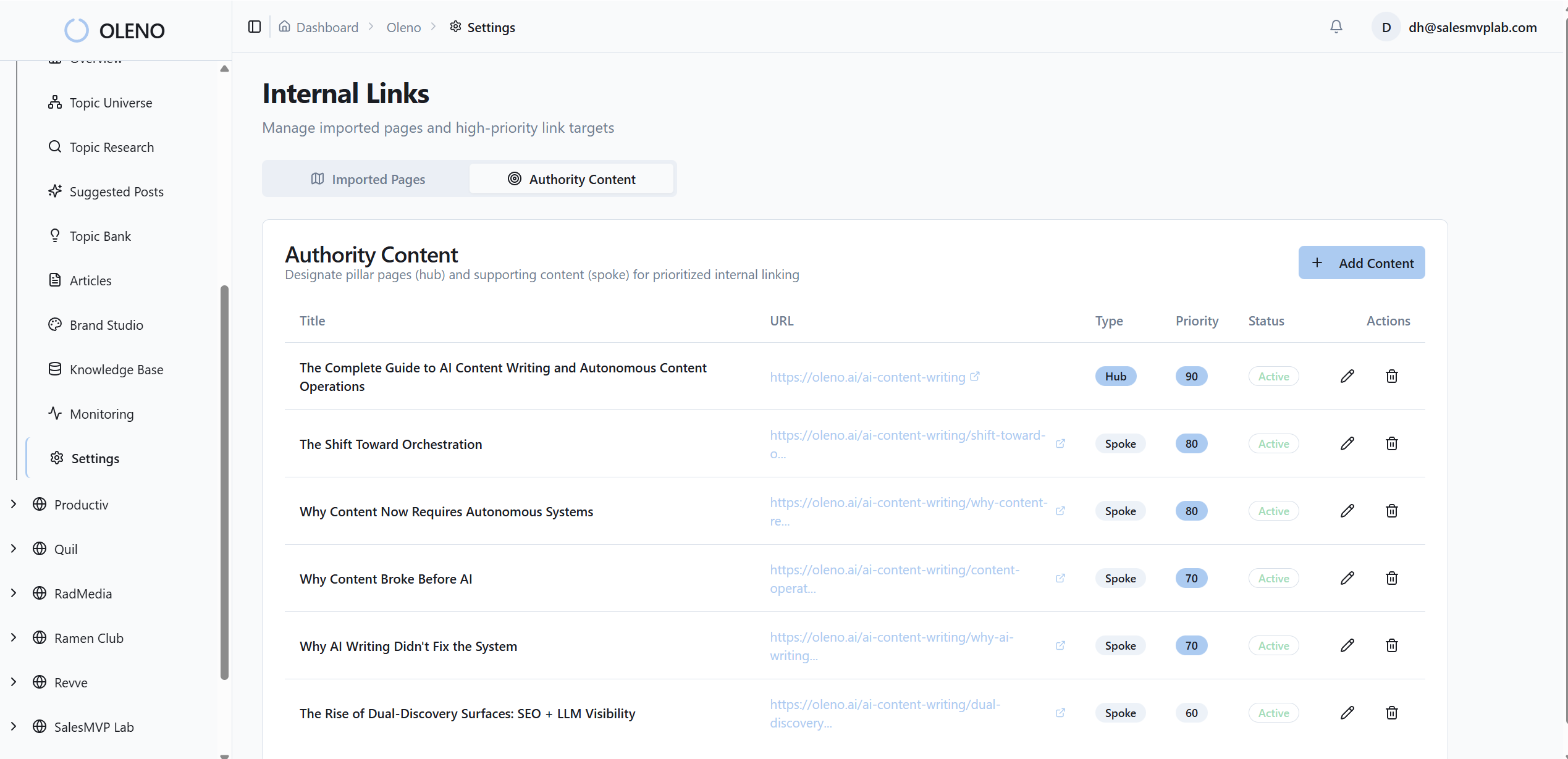
QA evaluates 80+ checks and requires a minimum passing score of 85. Low scores trigger refinement loops automatically. Publishing supports WordPress, Webflow, HubSpot, and Google Sheets with field mapping, duplicate prevention, and safe draft modes. Fewer rollbacks. Fewer surprises. More time on narrative and product stories.
Want to see the pipeline run end to end, from topic to publish? Try Oleno for Free. Try Oleno for Free
Conclusion
Here’s the thing. You don’t fix scale with sharper prompts. You fix it by turning content into a system, strategy mapped to coverage, briefs gated for originality, and mechanics enforced in code. Do that and the work changes. Fewer late edits. Fewer rollbacks. More articles that actually move the story you want to tell.
About Daniel Hebert
I'm the founder of Oleno, SalesMVP Lab, and yourLumira. Been working in B2B SaaS in both sales and marketing leadership for 13+ years. I specialize in building revenue engines from the ground up. Over the years, I've codified writing frameworks, which are now powering Oleno.
Frequently Asked Questions