Blaze vs Surfer: Which Should You Choose?

If you’ve ever tried to scale SEO content with a pile of prompts and a Google Doc, you know the feeling. It starts out kind of fun. Then it turns into this daily grind of copy-paste, cleanup, “does this sound like us?”, and publishing busywork that somehow eats 3 hours a day.
This piece is a straight comparison of Surfer vs Blaze vs Oleno, written for B2B SaaS marketing teams who care about SEO outcomes, brand consistency, and not waking up to a blog full of duplicates or off-brand claims.
Quick comparison of Surfer vs Blaze vs Oleno
Surfer is primarily an SEO optimization suite with an AI writer attached, Blaze is built for multi-format marketing content (including visuals), and Oleno is built as an autonomous engine that queues topics, writes, QA’s, and publishes content. That difference matters because tool choice usually comes down to whether your bottleneck is SEO optimization, multi-channel output, or operational throughput. If you want one line: Surfer tunes content, Blaze produces variety, Oleno runs the pipeline.
| Feature | Surfer | Blaze | Oleno |
|---|---|---|---|
| Primary focus | SEO optimization + AI writing (Surfer tools overview) | Multi-format marketing content + visuals (Blaze overview) | Autonomous programmatic SEO engine (first-party) |
| Typical workflow | Analyze SERPs, optimize drafts to a score (How Surfer works) | Generate content in many formats, including branded assets (Blaze updates) | Queue topics, write, QA, publish to CMS (first-party) |
| Integrations mentioned | Google Docs, WordPress, GSC (Surfer review) | App + web product, product updates on site (Blaze updates) | Direct publishing to WordPress, Webflow, Storyblok, HubSpot (first-party) |
| Where it can fall short | More “optimize content” than “run content ops” (Surfer review) | Less SEO-native depth than an SEO suite (Blaze overview) | Narrower focus on long-form acquisition content (first-party) |
| Best fit (in practice) | SEO managers obsessed with on-page + SERP alignment | Marketing generalists doing lots of channels | Lean B2B teams who want volume with governance |
Key Takeaways:
- Surfer is a strong pick when your main problem is on-page SEO tuning and SERP-driven content scoring, not end-to-end publishing automation.
- Blaze is a fit when you need lots of formats (social, ads, visuals) and you’re less strict about SEO scoring workflows.
- Oleno is built for teams trying to scale programmatic SEO with governance, QA checks, and direct CMS publishing baked into the flow.
- If your team is stuck in “prompting as a job,” the biggest win usually comes from automating the pipeline, not adding more templates.
What usually breaks when you try to scale SEO content
Scaling SEO content breaks when the process stays manual, even if the writing is “AI-assisted.” The hidden cost is coordination and rework, not word count. You see it when drafts bounce between stakeholders, publishing is a separate chore, and every article needs a custom prompt to avoid sounding generic. That’s how a team can “produce content” and still feel behind every week.
I’ve lived this a few times. Early on, you can brute force it. You’re the context holder, you know the product, you know the positioning, and you can crank out posts fast. Then the team grows. Suddenly the writer doesn’t have your context, you’re in meetings all day, and the system collapses into a backlog.
Here are the failure modes I see most often:
- Brand drift: every new writer or prompt variant changes the tone.
- Factual drift: product details and competitive claims get loose over time.
- Ops drift: publishing, linking, formatting, and refreshing become “someone’s Friday afternoon task.”
- SEO drift: you publish, but you never build enough coverage to earn topical authority.
That context matters, because Surfer and Blaze solve different pieces of this. Oleno is trying to solve the whole chain.
Surfer vs Blaze vs Oleno for B2B SaaS SEO teams
For B2B SaaS SEO, Surfer is usually the “optimize what we’re already writing” tool, Blaze is the “we need more marketing output in more places” tool, and Oleno is the “we need a production system that doesn’t rely on heroic effort” tool. The right pick depends on where your bottleneck sits: optimization, multi-format creation, or operational execution. Most teams pick wrong because they buy for the symptom they feel today, not the constraint that will hit them at 200 or 2,000 pages.
A simple way to decide is to be honest about your weekly reality. Are you staring at an SEO content score and trying to beat competitors by a few points? Or are you staring at an editorial calendar that never ships because publishing is a mess? Or are you trying to keep up with demand gen, social, and product marketing requests without cloning yourself?
We’ll break down Surfer and Blaze cleanly, then I’ll show where Oleno fits if you want something closer to an autonomous engine.
Surfer review: where it’s strong, and where teams get stuck
Surfer is strongest when you want SERP-driven guidance and on-page optimization signals, because it’s built as an SEO suite first and an AI writer second. That shows up in workflows like content scoring, audits, and research tied to what’s ranking. If your team already has writers and you want to tighten SEO execution, Surfer can be a practical addition (Surfer SEO review).
The flip side is that Surfer doesn’t magically become your content operations system just because it can generate a draft. In a lot of teams, the “hard part” isn’t writing the first draft. It’s getting to a publishable draft, keeping it on-brand, and pushing it into the CMS consistently, week after week.
Surfer’s core workflow is “optimize to the SERP”
Surfer’s product is oriented around analyzing what’s ranking and giving you targets to hit, then helping you edit toward those targets. That includes workflows like using their Content Editor and following optimization guidance (How to use Surfer SEO). If you like working from a structured editor with SEO guidance in your face, that’s the appeal.
And to be fair, that’s not a small thing. A lot of teams publish content that’s “good writing” but structurally weak for search. They miss basic stuff like headings that match intent, coverage depth, and keyword variants that show topical relevance. Surfer pushes you toward a more disciplined SEO shape.
Surfer’s strengths, in plain terms:
- Clear SERP-driven optimization workflow (How to use Surfer SEO)
- SEO tooling that goes beyond writing, including audits and analysis (Surfer SEO review)
- Product releases and ongoing improvements are documented publicly (Surfer release notes)
Where Surfer can become a time sink for lean teams
Surfer can still leave you with a bunch of manual steps around content ops. You might optimize in Surfer, then paste into docs, then paste into a CMS, then someone has to QA tone and facts, then someone has to worry about duplicates. That’s where smaller B2B teams quietly lose the week.
Also, Surfer’s “north star” is SEO alignment. That’s great, until your CMO asks the other question: is this content actually persuasive? Does it create pipeline? That part isn’t Surfer’s job, and you shouldn’t expect it to be.
Common friction points I’ve seen (and you might nod along):
- SEO optimization doesn’t equal “publish-ready,” you still need editing and governance.
- Getting volume out requires process discipline outside the tool.
- If your team wants hands-off publishing, Surfer isn’t designed as a CMS-first engine (Surfer SEO review).
How Oleno is Different: Surfer is mainly about optimizing what you write. Oleno is built to run the full queue, write, QA, publish loop, so the “paste it into the CMS” step (and the duplicate-risk step) doesn’t become your permanent bottleneck.
Blaze review: a better fit for multi-format marketing than SEO purists
Blaze is stronger for teams that need lots of marketing content formats, because it’s positioned around generating content across many use cases, including visuals and branded assets. That’s a different job than SERP-first optimization. If you’re trying to feed social, ads, email, and maybe blog, Blaze is aiming at that broader output problem (Blaze AI review).
Where Blaze is usually weaker for an SEO manager is the “SEO-native depth” side. You can absolutely write blog content with a general marketing generator, but you’ll often end up stitching together your SEO process using other tools and your own discipline.
Blaze is designed for breadth of formats
The positioning is clear: Blaze is about content creation across lots of formats, and it leans into brand and creative output, including visual content capability (as described in third-party overviews) (Blaze platform overview). Blaze also maintains a product update feed that shows active development (Blaze updates).
If your day looks like “write a post, cut it into LinkedIn content, draft an email, make some creative,” that breadth matters. You don’t want three separate tools and a messy handoff.
Blaze tends to fit:
- Solo marketers and small teams shipping across channels (Blaze AI review)
- Teams who care about brand assets alongside text (Blaze platform overview)
- People who want an app-style experience (Blaze also has an iOS presence) (Blaze iOS app listing)
Where Blaze can be limiting for SEO scale
If your goal is programmatic SEO at volume, you usually want a system that thinks in queues, topics, QA gates, and publishing reliability. Blaze can still be part of the stack, but it’s not primarily framed as “generate and publish 20 comparison pages a week without duplicates.”
Also, SEO teams care about consistency across hundreds of pages. That includes internal governance, factual grounding, and a repeatable pipeline. Blaze’s public messaging leans more toward creative breadth than strict SEO operations (Blaze platform overview).
Friction points to watch:
- You may need to bring your own SEO framework and process.
- Multi-format output can distract from building topical depth.
- Publishing operations are still a “make sure it got done” job unless your workflow is very tight.
How Oleno is Different: Blaze is built to generate lots of marketing formats. Oleno is narrower, but it’s intentionally narrow: long-form acquisition content where governance, QA, and direct CMS publishing determine whether you can scale without chaos.
The pricing question nobody asks until it’s too late
Surfer and Blaze both tend to look cheaper at first glance than a system built for governed volume. That’s normal. The real cost shows up later in headcount time: editing, rewriting, publishing, and the meetings required to keep content from drifting off brand.

Here’s what we can say from the provided sources without guessing. Surfer is positioned as a paid SEO tool with ongoing product updates and feature releases (Surfer release notes). Blaze presents itself as a product with a free entry point in some coverage and ongoing releases, and you can see their public updates and product presence (Blaze updates).
Oleno starts at from $449/month (first-party), and the pricing is tied to output volume (posts per day), which is a very different mental model than “seats” or “credits.” That model is basically admitting the truth: if you want volume, you should pay for volume.
Practical guidance I use when budgeting:
- Estimate how many publishable pages you need per month, not how many drafts.
- Estimate how many hours per page your current process takes end-to-end.
- Multiply by an actual loaded hourly cost, because “free” content isn’t free when a manager is rewriting it at night.
- Then compare tools based on whether they remove steps, not whether they generate words.
Surfer vs Blaze for SEO teams: which one makes more sense?
Surfer usually makes more sense than Blaze for SEO teams when your work is anchored in SERP analysis and on-page optimization discipline. Blaze can still be useful, but it’s not framed as an SEO suite in the same way. That becomes obvious the moment you try to standardize content production across dozens of pages and you need everyone following the same SEO criteria (How to use Surfer SEO).

Still, Blaze has a real place. If the marketing org expects you to feed multiple channels, the format breadth can be a legit advantage, especially for a small team that can’t afford separate tools for every channel (Blaze AI review).
A quick way to think about it:
- If the SEO manager owns success metrics and wants tighter SERP alignment, Surfer tends to fit the job description (Surfer SEO review).
- If the marketing manager is drowning in “we need content everywhere,” Blaze tends to match that request better (Blaze platform overview).
Where Oleno comes in is when neither of those solves the core operational problem: shipping a lot of pages without brand and factual drift.
The real differentiator at scale is governance, not creativity
Governance is the differentiator when you’re shipping at scale, because the cost of mistakes compounds across hundreds of pages. One weird product claim can get copied into 50 posts. One off-brand tone can quietly dilute positioning. And once you’ve published 1,000 pages, cleaning it up is brutal.
This is also where a lot of “AI content” debates get dumb. People argue about whether AI can write. Of course it can write. The question is whether your org has a system that prevents failure modes: hallucinated facts, inconsistent positioning, repetitive pages, and publishing duplication.
That’s why you see tools splitting into categories:
- SEO suites that add AI writing, like Surfer (Surfer SEO review)
- Marketing creation tools that broaden formats, like Blaze (Blaze AI review)
- Production engines that are designed as pipelines, which is where Oleno sits (first-party)
Comprehensive comparison table: Surfer vs Blaze vs Oleno
This table is the fastest way to compare Surfer, Blaze, and Oleno across the things B2B SaaS teams actually care about. Surfer is clearly documented as an SEO toolset with a content workflow and ongoing updates, Blaze is documented as a multi-format content tool with active releases, and Oleno focuses on an autonomous content engine with CMS publishing and QA gates. Use this table to map your bottleneck to the tool’s actual design center.
| Feature Category | Surfer | Blaze | Oleno |
|---|---|---|---|
| SEO suite (audit, SERP analysis) | ✓ (Surfer SEO review) | ✗ / not primary focus (Blaze platform overview) | ✓ (SEO Studio, first-party) |
| AI writing included | ✓ (Surfer SEO review) | ✓ (Blaze AI review) | ✓ (first-party) |
| Multi-format marketing content | Limited / not primary focus (Surfer SEO review) | ✓ (Blaze AI review) | Focused on long-form acquisition content (first-party) |
| Visual content emphasis | Not emphasized (Surfer SEO review) | ✓ (Blaze platform overview) | ✗ (not focus, first-party) |
| Content editor workflow | ✓ (How to use Surfer SEO) | ✓ (general creation, implied by product overview) (Blaze updates) | ✓ (pipeline output, first-party) |
| Public release notes / updates | ✓ (Surfer release notes) | ✓ (Blaze updates) | ✓ (first-party roadmap, not cited externally) |
| Publishing automation to CMS | Mentioned integrations like WordPress (Surfer SEO review) | Not positioned as CMS-first in provided sources (Blaze platform overview) | ✓ direct publishing to WordPress, Webflow, Storyblok, HubSpot (first-party) |
| Duplicate prevention (idempotent publishing) | Not stated in provided sources | Not stated in provided sources | ✓ (first-party) |
| Governance layer (brand/product rules) | Not described as core feature in provided sources | Brand templates mentioned broadly (Blaze platform overview) | ✓ Brand, Marketing, Product studios (first-party) |
| QA gate before publishing | Not described as core feature in provided sources | Not described as core feature in provided sources | ✓ automated QA Gate (first-party) |
| Knowledge grounding on your internal info | Not described as core feature in provided sources | Not described as core feature in provided sources | ✓ Knowledge Archive (first-party) |
| Best fit | SEO teams optimizing content performance (How to use Surfer SEO) | Small teams producing lots of formats (Blaze AI review) | B2B teams scaling governed programmatic SEO (first-party) |
If you want to see how Oleno looks in your specific workflow, you can request a demo. The fastest way to evaluate it is to map your current steps (topic, draft, edits, QA, CMS) and see which ones disappear.
Why Oleno fits teams scaling programmatic SEO (and where it’s not the right tool)
Oleno fits when your problem is operational: you need to publish a lot of pages without brand drift, factual drift, or a manual CMS process that eats your week. It’s built as an autonomous content engine that queues topics, writes them, QA’s them, and posts them, which is basically what most marketers are trying to duct-tape together with prompts and spreadsheets. If you’re producing comparison and alternative pages at volume, the deterministic pipeline matters more than having 100 creative templates.
Here’s the founder story in one breath, because it explains the product shape. Last summer I was marketing a B2C app and I went hard on SEO and GEO. I did the “make a bunch of GPTs and keep copy-pasting into the CMS” thing. It worked, but it was a complete waste of time, 3 to 4 hours a day of repetitive ops. So I hard-coded an autonomous content engine right into the CMS. Topics got queued, posts got written, QA’d, and published. It started indexing quickly. Then coaching clients kept asking to use it, and after enough people asked, it became Oleno.
What Oleno actually does differently than Surfer and Blaze
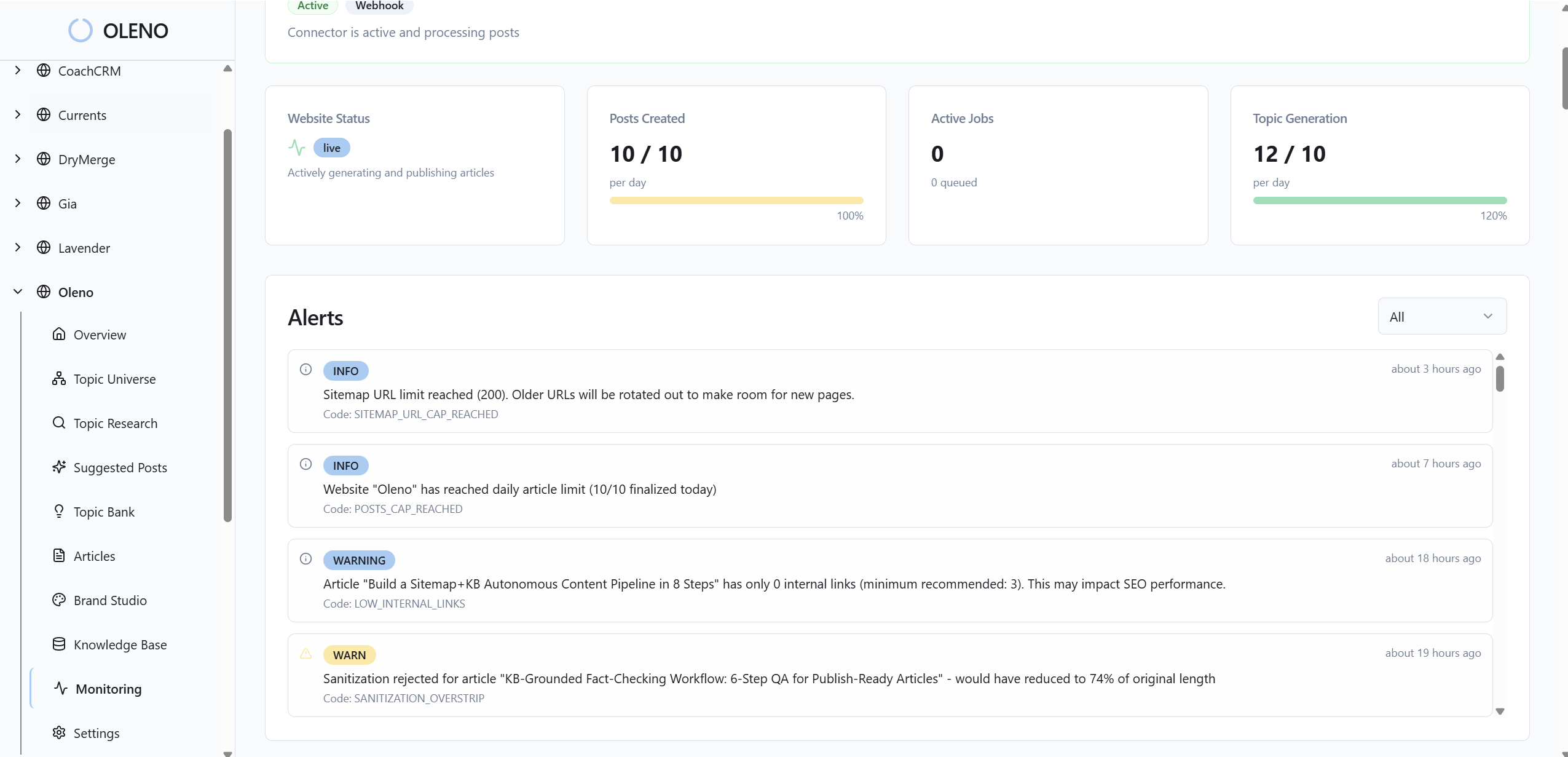
Oleno’s core difference is that it treats content like a production system, not a writing session. Surfer helps you optimize content against SEO criteria, and Blaze helps you generate a lot of marketing formats, but Oleno is built around governed throughput: brand rules, product facts, marketing messaging, SEO intent, and competitive positioning get encoded into the Studios, then the engine executes consistently.
In practice, the pieces that matter are:
- Studios as governance: Brand, Marketing, Product, SEO, Competitive, so content doesn’t drift (first-party).
- Knowledge Archive grounding: generation pulls from your approved info so factual errors are less likely (first-party).
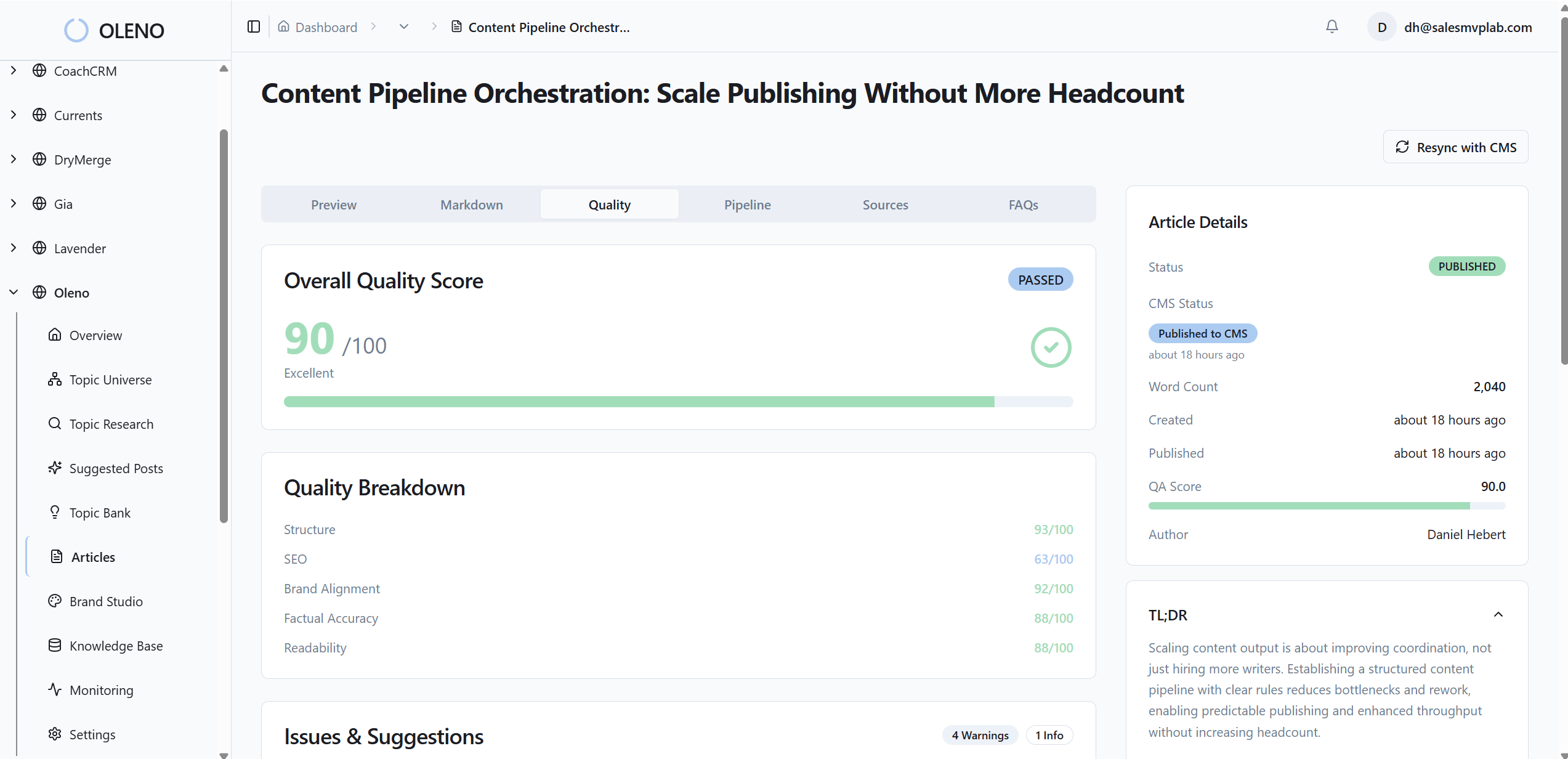
- QA Gate: automated checks before publishing so low-quality output doesn’t sneak through (first-party).
- Direct CMS publishing with idempotency: publish to WordPress, Webflow, Storyblok, HubSpot without accidental duplicates (first-party).
That’s the stuff that shows up after you’ve shipped 200 pages and your org is asking for 800 more.
The honest tradeoff
Oleno is not trying to be your everything marketing tool. If your day is mostly paid ads, social creative, and a bunch of different short-form assets, Blaze might feel more natural because it’s oriented around breadth of formats (Blaze AI review).
Oleno is also not a pure SEO optimizer in the Surfer sense, where you live inside a SERP-based editor and tune content to a score (How to use Surfer SEO). Oleno’s angle is: get the pipeline working, keep it governed, ship consistently, then improve.
If you’re the CMO or Head of Content and you’re thinking, “I just want this to run without me babysitting it,” that’s the lane.
What I’d do if I were choosing for a real team
Surfer is the pick if you already have writers and you want an SEO system for optimization discipline, because that’s what the product is centered on (Surfer SEO review). Blaze is the pick if marketing needs multi-channel output and you want one tool that covers a wide range of formats, including creative elements (Blaze platform overview).
Oleno is the pick if the bottleneck is end-to-end throughput and governance, and you need the machine to keep producing without someone copy-pasting drafts into the CMS every day.
If you’re torn, try this gut check. Which of these is your actual pain?
- “We publish, but we don’t rank.” That leans Surfer.
- “We need content everywhere.” That leans Blaze.
- “We can’t ship fast enough, and quality control is exhausting.” That leans Oleno.
What to do next if you’re evaluating tools right now
You don’t need a 6-week evaluation cycle for this. You need a reality check and a small pilot.
A simple evaluation plan:
- Pick 10 topics you actually want to rank for.
- Run them through the tool using your real constraints (approvals, voice, product claims).
- Time every step from topic to published, not just draft generation.
- Track how much editing was required, and who had to do it.
If you want to see whether Oleno matches your workflow, book a demo and bring one messy example, like a comparison page that always takes forever. That’s usually where the truth shows up fastest.
You can also request a demo if you’re earlier in the process and just want to sanity-check fit against Surfer or Blaze.
The main thing I’d avoid is buying another tool that still leaves you with the same manual pipeline. That mistake doesn’t show up on day one. It shows up three months later, when you’re back in copy-paste land, wondering why content still feels like pushing a boulder uphill.
About Daniel Hebert
I'm the founder of Oleno, SalesMVP Lab, and yourLumira. Been working in B2B SaaS in both sales and marketing leadership for 13+ years. I specialize in building revenue engines from the ground up. Over the years, I've codified writing frameworks, which are now powering Oleno.
Frequently Asked Questions